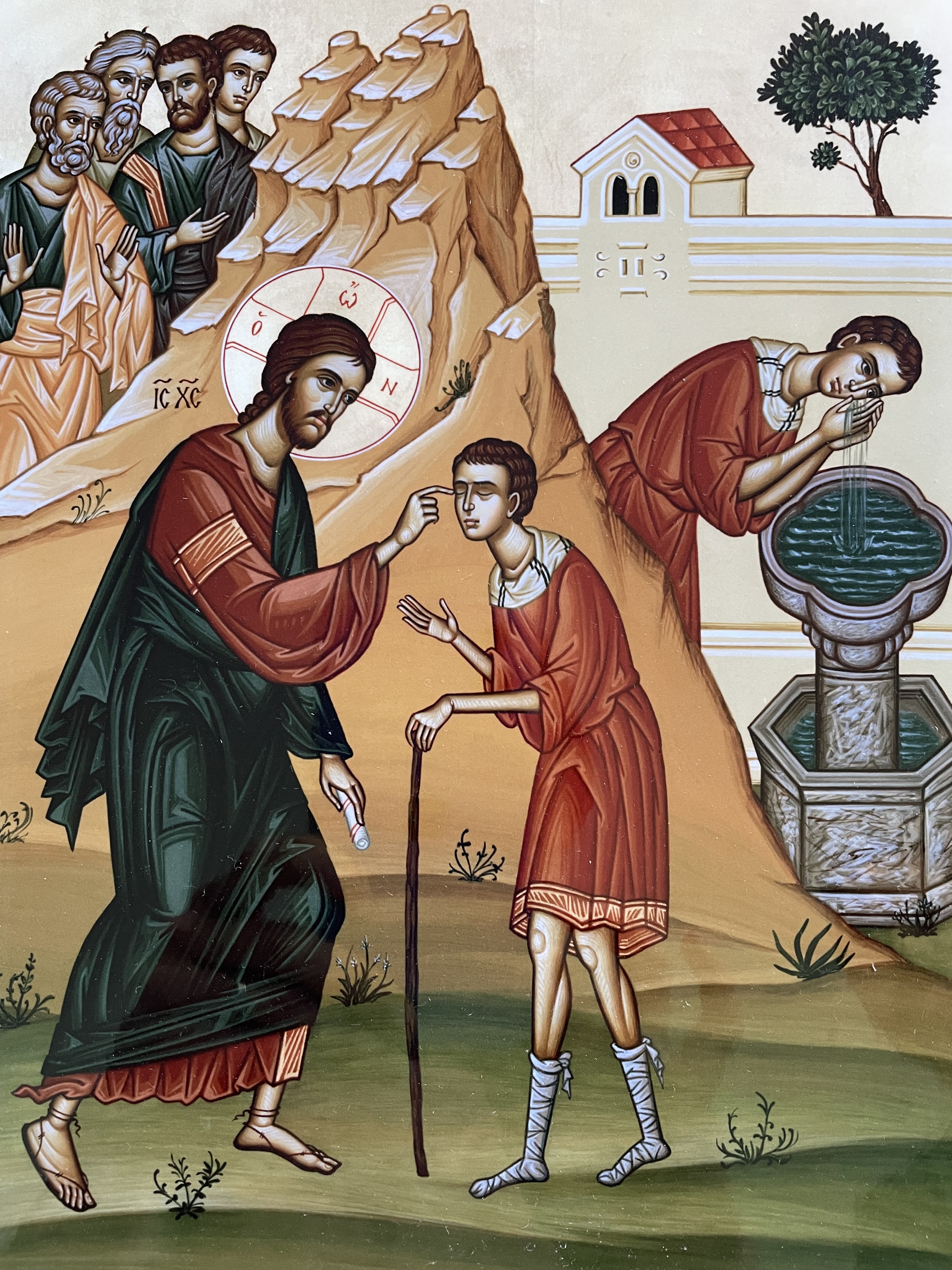
“When they reached the place called The Skull, there they crucified Him and the two criminals, one on His right, the other on His left. Jesus said, ‘Father, forgive them; they do not know what they are doing.’ Then they cast lots to share out His clothing . . . One of the criminals hanging there abused Him: ‘Are you not the Christ? Save yourself and us as well.’ But the other spoke up and rebuked him. ‘Have you no fear of God at all?’ he said. ‘You got the same sentence as He did, but in our case, we deserved it: we are paying for what we did. But this man has done nothing wrong.’ Then he said, ‘Jesus, remember me when you come into your kingdom.’ He answered him, ‘In truth I tell you, today you will be with me in paradise.’ It was now about the sixth hour and the sun’s light failed, so that darkness came over the whole land until the ninth hour. The veil of the Sanctuary was torn right down the middle. Jesus cried out in a loud voice saying, ‘Father, into your hands I commit my spirit.’ With these words He breathed His last” (Luke 23:33-46).
Dear brothers and sisters in Christ,
As we continue our Lenten healing journey this Holy Week, we have come to the greatest healing story of all time—the passion and resurrection of our Lord. Jesus, the shepherd and guardian of our souls, bore our sins in His body on the Cross, healing us through His wounds (1 Peter 2:24-25). “Ours were the sufferings He was bearing, ours the sorrows He was carrying . . . He was being wounded for our rebellions, crushed because of our guilt; the punishment reconciling us fell on Him, and we have been healed by His bruises” (Isaiah 53:4-5).
In today’s passage, the good thief received this healing of soul through Jesus’s wounds, and the Lord assured him, “today you will be with me in paradise.” God wants the same for each of us (1 Timothy 2:4)! Furthermore, when we look at Jesus on the Cross in faith, there is a deep healing that comes in our daily lives as we encounter God’s love and presence in our sufferings and when we receive the grace to trust that, ultimately, healing—not hurt—will prevail.
As we gaze upon Jesus on the Cross, we begin to grasp how deep and wide the love of Christ is (Ephesians 3:18-19). His arms are stretched wide open for each of us. With these arms, and by the wounds on His hands, He has redeemed us (Psalm 77:15; John 20:20, 27). Although the devil sometimes exploits our wounds to make us doubt God’s love for us, the truth is, by His wounds, the Lord has already loved us perfectly and completely. John 3:16 is made visible on the Cross—“this is how God loved the world: He gave His only Son, so that everyone who believes in Him may not perish but may have eternal life.” As Romans 5:8 says, this “is proof of God’s own love for us, that Christ died for us while we were still sinners.” There is nothing more He could give because in accepting death on the Cross, Jesus has already emptied Himself completely for you and for me (Philippians 2:7-8). Therefore, we are called to trust in His love (Psalm 52:8).
Since God did not spare His own Son, but gave Him up for our sake, nothing can cut us off from the love of Christ, “neither death nor life, nor angels, nor principalities, nothing already in existence and nothing still to come, nor any power, nor the heights nor the depths, nor any created thing whatever, will be able to come between us and the love of God, known to us in Christ Jesus our Lord” (Romans 8:32-39). This includes the wounds within each of us—neither shame, nor fear, nor scrupulosity, nor lies about our identity, nor feelings of being unloved or unlovable, nor any hurt whatsoever—can cut us off from the love of Christ when we cling to Him. Cling to Jesus in love, and He will free you (Psalm 91:14).
No matter what you are facing this Holy Week, God’s perfect and complete love for you continues today. God is love (1 John 4:8), and the Lord, who takes pity on us, has promised, “my faithful love will never leave you” (Isaiah 54:10). Indeed, on Holy Thursday, we will hear from the Gospel of John that Jesus loved those who were His in the world “to the end” (John 13:1). And so, let us give thanks to the Lord for He is good, and His faithful love endures forever (Psalm 136:1).
When we fix our eyes on Jesus on the Cross, we also see that He understands, and is with us in, our sufferings. The Scriptures describe Him as “a man of sorrows, familiar with suffering” (Isaiah 53:3). Likewise, Hebrews 4:15-16 reminds us that “the high priest we have is not incapable of feeling our weaknesses with us but has been put to the test in exactly the same way as ourselves, apart from sin” and encourages us to “have no fear in approaching the throne of grace to receive mercy and to find grace when we are in need of help.”
When we do, we will have the beautifully loving experience of the prodigal son in Luke 15:20—“while he was still a long way off, his father saw him and was moved with pity. He ran to the boy, clasped him in his arms and kissed him.” In our painful moments, too, the Lord is with us (Matthew 28:20), eager to envelop us in, and heal us through, His love. We are His beloved sons and daughters (John 1:12; 1 John 3:1). As we venerate the Cross on Good Friday, may we remember that God sent His Son to redeem us so that we could receive adoption as His sons and daughters (Galatians 4:4-5). Jesus promised, “I shall not leave you orphans; I shall come to you” so that we may be healed and live (John 14:18-19)!
Finally, looking at Jesus on the Cross reminds us that, after Good Friday, the joy of the Risen Lord comes with Easter Sunday. In our lives too, healing—not hurt—will have the last word. The Lord is healing us, transforming us through the Holy Spirit into His image in brighter and brighter glory (2 Corinthians 3:18). His mercies are new every morning (Lamentations 3:23), and for those who love God and are called according to His purpose, He turns everything to their good (Romans 8:28). This includes the painful parts of our lives. The Lord takes our sufferings and turns them into encouragements, not only for ourselves but also for one another (2 Corinthians 1:3-7).
God took the hurt that Jesus suffered on the Cross and turned it into healing salvation for all of us. We are called to do the same—not to transfer our hurts to one another as hurts, but to transfer them as healings. In every struggle, then, may we hear the Lord encouraging us, “take this, all of you, and eat of it,” as we open ourselves to all the ways He is nourishing and strengthening us in our momentary afflictions (2 Corinthians 4:17) and leading us to do the same for our brothers and sisters. May the Lord continue to heal us so that we may love Him and one another more and more; “thanks be to God for His gift that is beyond all telling” (2 Corinthians 9:15)!
 Grace and Truth
Leave a comment