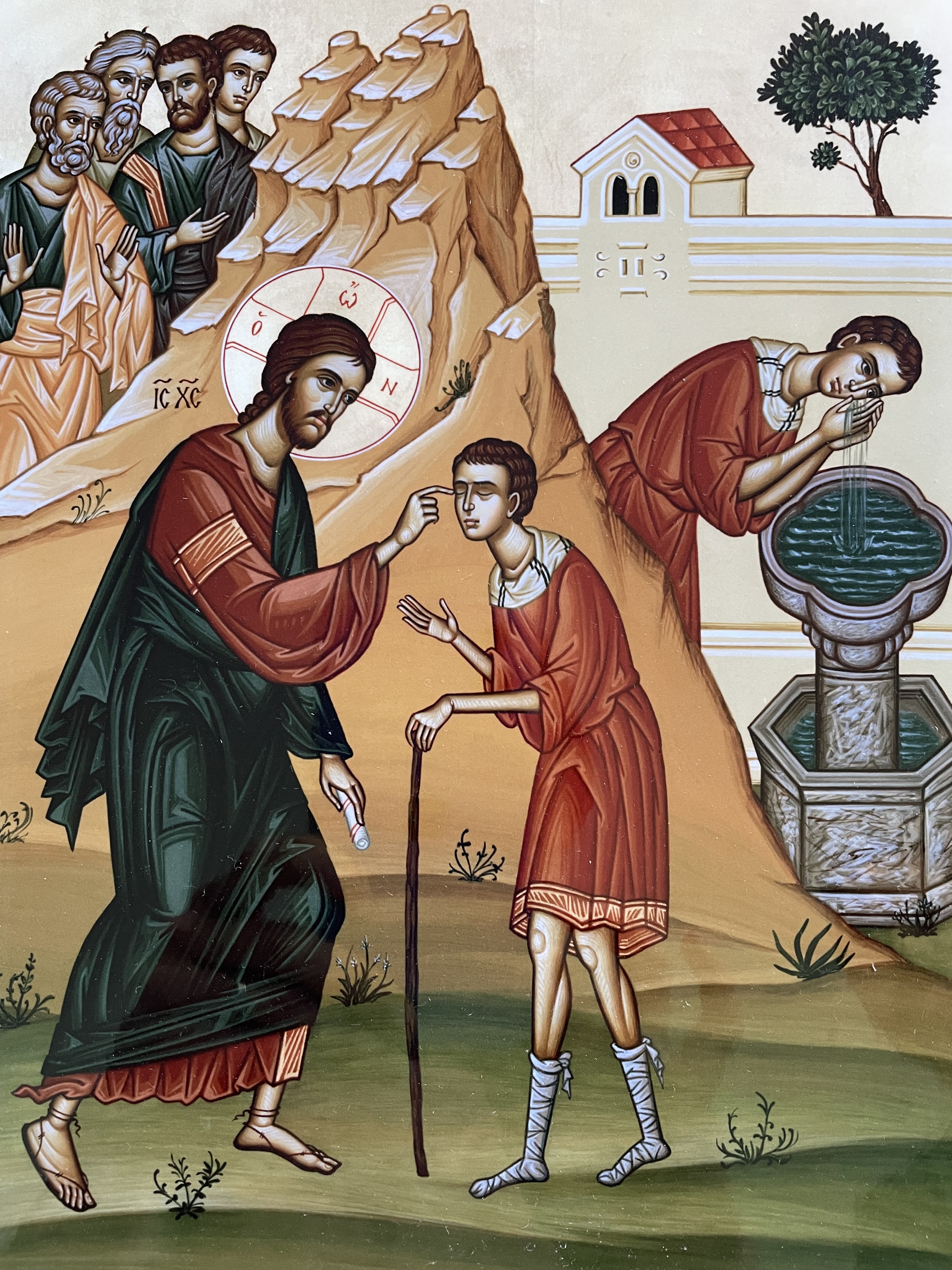
“They reached Jericho; and as He left Jericho with His disciples and a great crowd, Bartimaeus—that is, the son of Timaeus—a blind beggar, was sitting at the side of the road. When he heard that it was Jesus of Nazareth, he began to shout and cry out, ‘Son of David, Jesus, have pity on me.’ And many of them scolded him and told him to keep quiet, but he only shouted all the louder, ‘Son of David, have pity on me.’ Jesus stopped and said, ‘Call him here,’ So they called the blind man over. ‘Courage,’ they said, ‘get up; He is calling you.’ So throwing off his cloak, he jumped up and went to Jesus. Then Jesus spoke, ‘What do you want me to do for you?’ The blind man said to him, ‘Rabbuni, let me see again.’ Jesus said to him, ‘Go; your faith has saved you.’ And at once his sight returned and he followed Him along the road” (Mark 10:46-52).
Dear brothers and sisters in Christ,
As we are journeying through this Lenten season, let’s reflect next on Bartimaeus’s beautiful encounter with Jesus and, like him, pray for the grace to see again. The passage begins by describing Bartimaeus as a blind beggar. We can recognize ourselves in this description. From the beginning, God made us in His own image and likeness, and all that He made was very good (Genesis 1:26-27, 31). As 1 Timothy 4:4 reminds us, “everything God has created is good.” However, since the Fall, we also experience darkness and blindness. Sometimes because of the wounds we are carrying, we do not see as Jesus wants us to see or love as He wants us to love. Jeremiah 17:9 describes the human heart as “more devious than any other thing,” while Revelation 3:17 explains our condition as “wretchedly and pitiably poor, and blind and naked too.”
We should acknowledge our blindness and complete dependence on God’s mercy as Bartimaeus did. For as Jesus told the Pharisees, “if you were blind, you would not be guilty, but since you say, ‘We can see,’ your guilt remains” (John 9:41). In the face of these wounds that keep us from seeing and loving as the Lord has called us to, we can pray with Bartimaeus, “Jesus, have pity on me.”
Initially, many of the people in the crowd tried to dissuade Bartimaeus from crying out to Jesus. Rather than give up, though, Bartimaeus redoubled his efforts and cried out to Jesus all the louder. We also have to persevere in crying out to Jesus despite hardships and challenges (Romans 12:12). Like Bartimaeus, our faith will be tested. Some of our most painful tests can come from the unhealed parts within us. You may have experienced such testing already this Lent. But thankfully, with God’s grace, the testing of our faith produces perseverance, and when perseverance is complete, we will lack nothing (James 1:3-4), for perseverance wins us our lives (Luke 21:19). May the Lord turn our hearts towards the love of God and the perseverance of Christ (2 Thessalonians 3:5)!
As Bartimaeus persevered, Jesus heard his cry and called Bartimaeus to Himself. No matter what we are facing, we should never hesitate to cry out to Jesus, for the Lord draws near to us when we draw near to Him (James 4:8). When we call to Him, He will answer us (Psalm 91:15). When we search wholeheartedly for Him, we are sure to find Him (Jeremiah 29:13-14).
When the Lord calls us, do we respond like Bartimaeus? He jumped up, threw off his cloak, and went to Jesus. Likewise, the first disciples left what they were doing and followed Jesus “at once” (Matthew 4:18-22), while Zacchaeus hurried down from the sycamore tree and welcomed Jesus joyfully (Luke 19:6). Or do we sometimes respond with hesitation or worries like Jeremiah when the Lord called him? When the Lord appointed Jeremiah a prophet, he said, “‘Ah, ah, ah, Lord; you see, I do not know how to speak: I am only a child!’ But the Lord replied, ‘Do not say, ‘I am only a child,’ . . . Do not be afraid . . . for I am with you to rescue you’” (Jeremiah 1:5-8).
But Bartimaeus jumped up and went to the Lord, and Jesus asked him, “what do you want me to do for you?” This is a question on which we could reflect our whole lives with the Lord in prayer. He wants to hear from us; as Philippians 4:6 encourages, “tell God all your desires of every kind in prayer and petition shot through with gratitude.” The Scriptures are full of graces for which we can pray. In today’s passage, Bartimaeus asked Jesus to let him see again. We can ask the same!
Immediately, with one word from Jesus, Bartimaeus’s sight was restored. He was healed, and his darkness turned to light, as 2 Samuel 22:29 came true in his life—“my God lights up my darkness.” The Lord will do the same in our lives when we ask Him in faith. If we believe, God will grant us the grace to see His glory (John 11:40), to see His light with our own eyes (Tobit 3:17).
It is not only our eyes that the Lord heals, but also our hearts and the wounds within us that keep us from receiving God’s love and from loving Him and one another. What we see flows from what is within us (Luke 6:45). When God’s love and goodness are in our hearts (Romans 5:5), we will more often see the good in each person and situation that we encounter. Sirach 17:8-10 beautifully describes this process—God “put His own light in their hearts to show them the magnificence of His works, so that they would praise His holy name.”
Similarly, when the Spirit of truth is in us, we will see more of the truth about God, ourselves, and the people and situations we encounter (John 16:13). As 2 Corinthians 4:6 says, “It is God who said, ‘Let light shine out of darkness,’ that has shone into our hearts to enlighten them with the knowledge of God’s glory, the glory on the face of Christ.” To see goodness and truth is not only the result of God’s healing work in our lives, but it also brings us so much healing and strengthens us to stand firm against the destruction and lies of the devil that are the roots of our wounds (John 8:44, 10:10).
Today’s passage concludes with Bartimaeus following Jesus along the road once his sight returned. As our “everlasting light” (Isaiah 60:19), the Lord will illuminate us too so that we may follow Him, who is our Way (John 14:6). Let’s pray that the Lord would heal us so that we too may see Him, goodness, and truth in our daily lives and follow Him humbly more and more each day!
Finally, I would like to share with you a beautiful reflection from Pope Francis about how the Lord will illuminate even our wounds so that they may become sources of light for our brothers and sisters:
“We too are wounded — who isn’t in life? And they are often hidden wounds we hide out of embarrassment. Who does not bear the scars of past choices, of misunderstandings, of sorrows that remain inside and are difficult to overcome? But also of wrongs suffered, sharp words, unmerciful judgements? God does not hide the wounds that pierced his body and soul from our eyes. He shows them so we can see that a new passage can be opened with Easter: to make holes of lights out of our own wounds . . . Think about your wounds, the ones you alone know about, that everyone has hidden in their heart. And look at the Lord and you will see, you will see how holes of light come out of those wounds. Jesus does not accuse on the cross, but loves. He loves and forgives those who hurt him (cf. Lk 23:34). In this way, he converts evil into good; in this way, he converts and transforms sorrow into love.
Brothers and sisters, the point is not whether we are wounded a little or a lot in life; the point is what to do with my wounds — the little ones, the big ones, the ones that will leave their mark on my body, on my soul, forever. What do I do with my wounds? . . . You can allow them to infect you with resentment and sadness, or instead unite them to those of Jesus, so that these wounds may become luminous too . . . Our wounds can become springs of hope when, instead of feeling sorry for ourselves or hiding them, we dry the tears shed by others; when, instead of nourishing resentment for what was robbed from us, we take care of what others are lacking; when, instead of dwelling on ourselves, we bend towards those who suffer; when, instead of being thirsty for love for ourselves, we quench the thirst of those in need of us . . . And it is by doing this, the Scriptures say, that our wound is healed quickly (cf. Is 58:8), and hope flourishes anew . . . Do I look at the wounds others have and go with the wounded experience of my life to heal, to help others? This is today’s challenge for all of you, for each of you, for each one of us. May the Lord help us move forward.”


Leave a comment